In onze projecten we design concrete yet bold solutions that are vehicles for social change. We work in a wide range of domains, from mental health to restoring biodiversity and everything in between.
Some of the projects we are working on right now.
.jpg?key=md)
Together with Stichting De Verre Bergen, we are working on The City as a Classroom, an innovative learning pathway in which primary school pupils in Rotterdam gain new experiences in their own city in a playful and educational way.
In co-creation with children, teachers, cultural institutions, and city partners, we develop teaching materials that align with the curriculum, are practically applicable, and offer meaningful experiences. By playing, exploring, and experimenting in their own city, children develop into curious and engaged Rotterdammers.
photograph by Hester Blankestijn

The future of Hollands Noorderkwartier is marked by profound change. Water-system challenges are becoming increasingly intertwined with other societal transitions, such as the energy transition, freshwater availability, and the use of resources. This growing interconnection raises the question of how HHNK can continue to fulfil its public duty in the future, and how it can further develop and deploy its adaptive capacity to remain relevant to society in the long term (2050+).
In collaboration with HHNK, we are developing a concept and a vision for the future water system of Hollands Noorderkwartier in 2050 and beyond. The focus is on ensuring social and ecological justice in an uncertain future shaped by diverging and sometimes opposing dynamics.

This design research project focuses on renewing diagnostic practices in child and adolescent psychiatry. Rather than centering on fixed DSM labels, it focuses on the patterns in which young people become stuck, such as recurring interactions between behavior, relationships, and their environment. Together with young people, parents, and healthcare professionals, we develop alternative forms of diagnosis that better align with young people’s lived experiences and everyday clinical practice.
Building on the Patterns of Life model, the project explores how diagnostic processes can foster understanding, reduce stigma, and expand agency. Through research, user experience, co-creation and prototyping, we design and test concrete diagnostic processes and tools. At the same time, we investigate how design can support the adoption of new ways of thinking within a complex mental healthcare system.

In the municipality of De Bilt, a coalition of dedicated local partners wanted to fundamentally rethink how they work together across domains such as health, safety and livability. By uncovering their shared values, shaping a collective manifest, and rehearsing future scenarios through a roleplay tool, they explored what a value-driven collaboration could make possible, all with one purpose: to improve the everyday experience of living in the neighbourhood Bilthoven Zuid.
Team
Costanza Milano
Emilie Tromp
Meike Huisman
Partners
Marc Rinkes
Gemeente De Bilt
A neighbourhood like Bilthoven Zuid is a tiny, big society. National issues around social cohesion, shifting public identities, inequalities and growing tensions in public space are concentrated here in visible, everyday forms. Addressing these challenges is rarely straightforward. They overlap, reinforce one other, and require organisations to combine their efforts.
At the same time, it is a place with strong local networks and many committed professionals and residents who care deeply about where they live. Yet even when everyone shares the same intentions, collaboration often gets stuck in the invisible walls of silos: different mandates, different routines, and structures that pull people back into their own domain. The question was how to create a form of collaboration that feels coherent for the professionals involved, and ultimately, for the residents they serve.

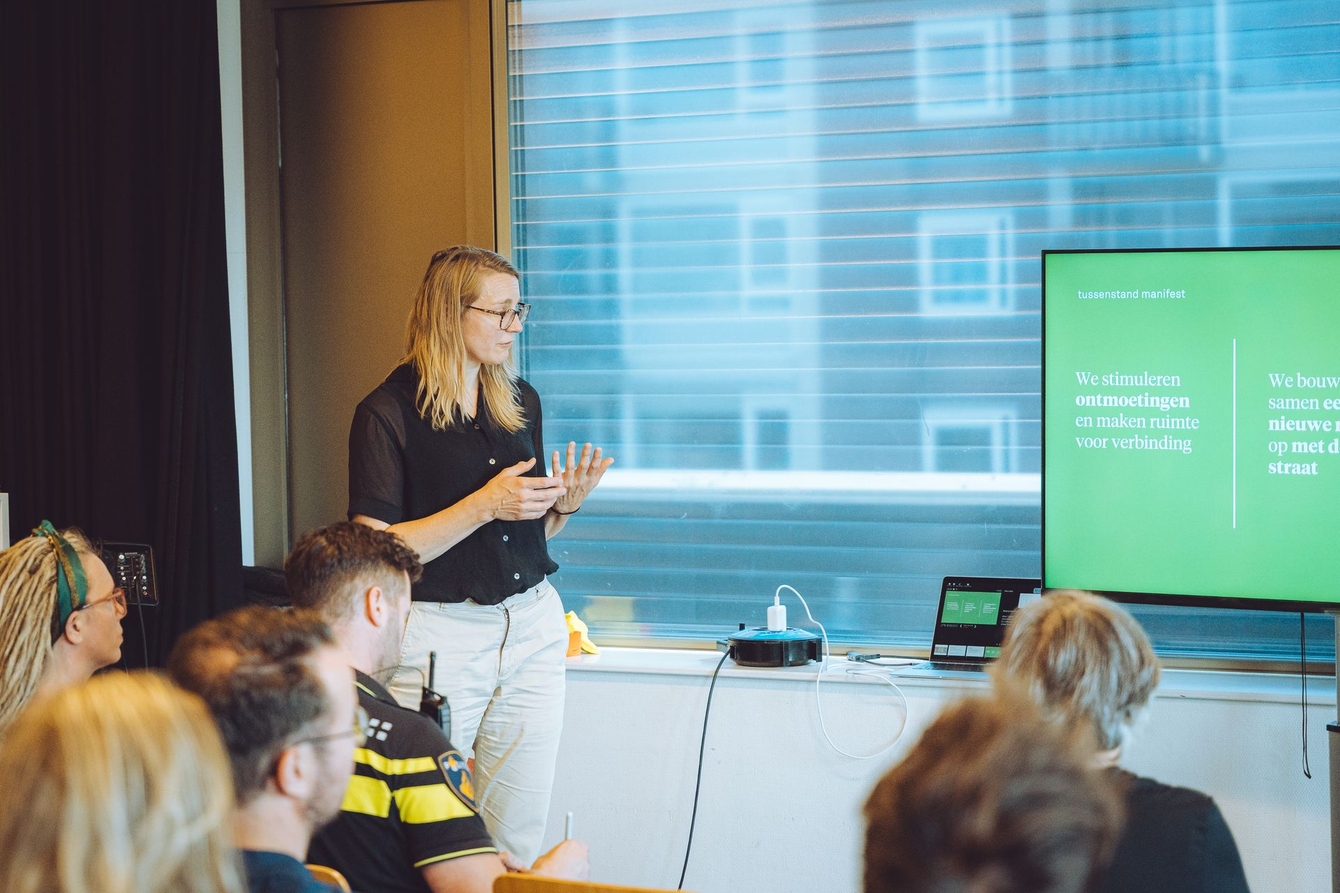
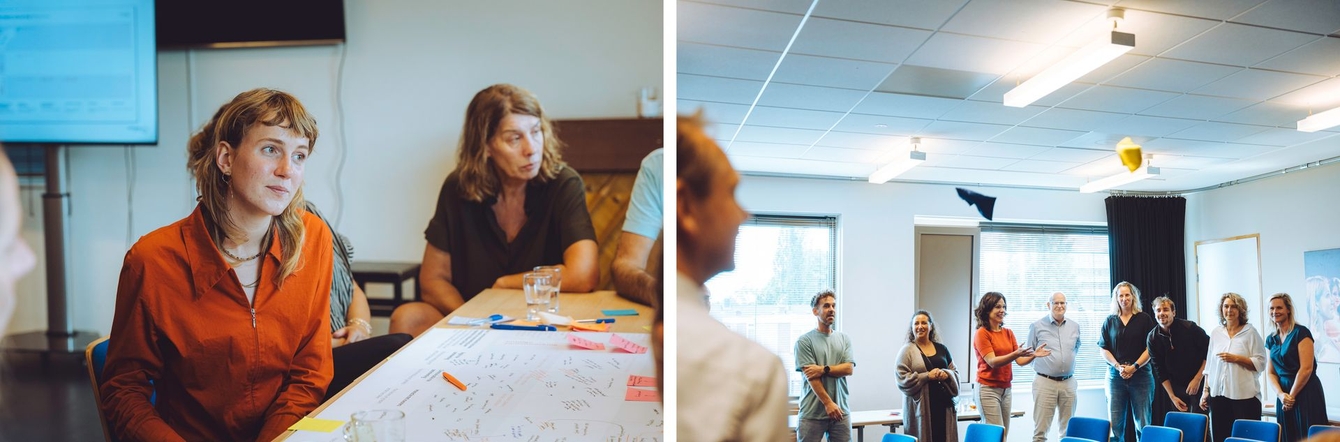
We started this project by focussing on shared values. That allowed partners to look beyond the day-to-day urgencies and reflect on the intrinsic motivations behind their work. More than forty-five professionals participated, from municipal policy leads and housing teams to youth workers, teachers, police officers, healthcare professionals, social workers and cultural partners. When these people explored what genuinely moves them in this neighbourhood clear patterns emerged. From these conversations we shaped a manifest for the future of the neighbourhood: a set of shared ambitions they all recognised and felt ownership of.
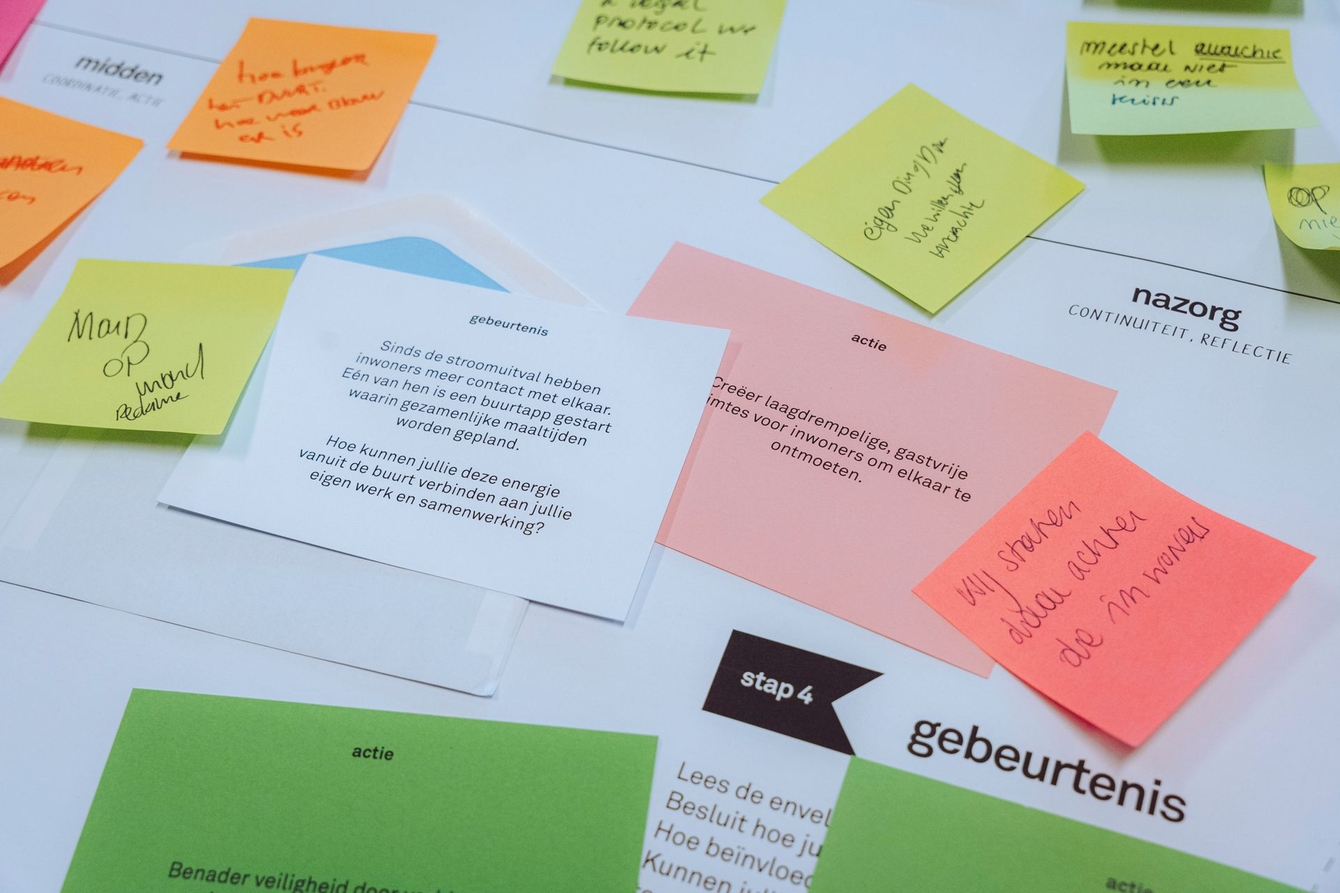
To make these ambitions concrete, we designed a roleplaying tool that allowed the coalition to rehearse future ways of working. During the game the professionals were given realistic scenarios: the arrival of a new family, a power outage with residents struggling behind closed doors, and a spontaneous citizen initiative. First they explored their usual response: What would my role be today? What would I normally do? Once that baseline was clear, we introduced simple action cards translating the manifest into practical behaviours. By playing these cards, they opened up new possibilities for collaboration. This helped them turn their ambitions into something tangible and concrete.
The roleplay revealed essential insights. Confusion about who should take the lead became visible. Signals from the neighbourhood were shown to disappear in layers of bureaucracy. And the sessions revealed how important informal contact is for sharing signals, building trust and understanding each-other’s perspectives.
As the roleplay unfolded, we saw roles naturally shift towards a more coalition-based way of working: partners recognised each other’s contribution, understood their interdependencies, and most importantly started acting from a shared purpose. Experiencing this firsthand made it easier for the coalition to imagine how the manifest could guide their work in daily reality, and to see collaboration not as an abstract ambition, but as something that can be practised and designed.

The coalition developed a shared compass and a clear collective identity. The manifest articulated a common direction, while the roleplay sessions translated it into behaviours that could be expressed in the streets, in meetings, and in moments of crisis. This eventually grew into a roadmap that anchors the collaboration in concrete routines and structures, from shared presence in the neighbourhood to redesigned meetings that prioritise early signals and coordinated action.
To give you an example: one of the pillars of the manifest focuses on the positive identity of the neighbourhood, on building a new relation to the street. By seeing the street as a shared space to build on, the coalition aims to strengthen pride, presence and a sense of belonging. During the role-play sessions, this pillar was explored using action cards such as “create accessible opportunities for people to develop.” and “encourage healthy behaviour and movement in everyday surroundings.” Playing these cards sparked new ideas for collaboration, including joint initiatives to create welcoming spaces for youth in the neighbourhood. This initiative was further elaborated in the roadmap with concrete steps to set up structures to make this possible.
Most importantly, professionals began recognising each other’s intentions, not just their mandates. That shift created a quality of alignment that no organisational chart could enforce, and one that residents can increasingly feel in their everyday interactions with the system around them.
What took shape in Bilthoven Zuid is relevant far beyond this neighbourhood. Municipalities across the Netherlands face similar questions: how can public organisations work together in a way that people genuinely experience and trust?
This project shows how design can make relationships visible, intentional and discussable. By designing a collaboration, rather than simply coordinating it, organisations can rehearse the future they want to create and begin embodying it in daily practices.
The result is a renewed sense of collective purpose. A collaboration that is not only better organised, but more meaningful, and a neighbourhood where residents experience a coherent and more responsive public presence around them.