In our projects we design concrete yet bold solutions that are vehicles for social change. We work in a wide range of domains, from mental health to restoring biodiversity and everything in between.
Some of the projects we are working on right now.
.jpg?key=md)
Together with Stichting De Verre Bergen, we are working on The City as a Classroom, an innovative learning pathway in which primary school pupils in Rotterdam gain new experiences in their own city in a playful and educational way.
In co-creation with children, teachers, cultural institutions, and city partners, we develop teaching materials that align with the curriculum, are practically applicable, and offer meaningful experiences. By playing, exploring, and experimenting in their own city, children develop into curious and engaged Rotterdammers.
photograph by Hester Blankestijn

The future of Hollands Noorderkwartier is marked by profound change. Water-system challenges are becoming increasingly intertwined with other societal transitions, such as the energy transition, freshwater availability, and the use of resources. This growing interconnection raises the question of how HHNK can continue to fulfil its public duty in the future, and how it can further develop and deploy its adaptive capacity to remain relevant to society in the long term (2050+).
In collaboration with HHNK, we are developing a concept and a vision for the future water system of Hollands Noorderkwartier in 2050 and beyond. The focus is on ensuring social and ecological justice in an uncertain future shaped by diverging and sometimes opposing dynamics.

This design research project focuses on renewing diagnostic practices in child and adolescent psychiatry. Rather than centering on fixed DSM labels, it focuses on the patterns in which young people become stuck, such as recurring interactions between behavior, relationships, and their environment. Together with young people, parents, and healthcare professionals, we develop alternative forms of diagnosis that better align with young people’s lived experiences and everyday clinical practice.
Building on the Patterns of Life model, the project explores how diagnostic processes can foster understanding, reduce stigma, and expand agency. Through research, user experience, co-creation and prototyping, we design and test concrete diagnostic processes and tools. At the same time, we investigate how design can support the adoption of new ways of thinking within a complex mental healthcare system.

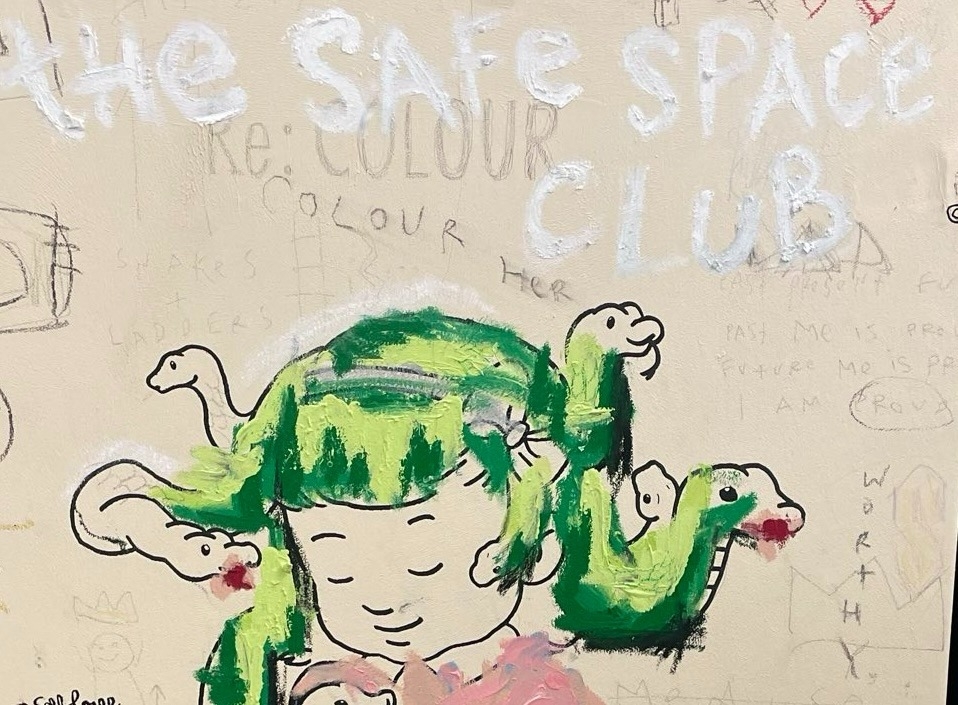
On a warm spring day, we met with the women of the Safe Space Club. They told us about how they created The Safe Space Club for women recovering from sexual trauma, and about their ambition to expand their impact, supported by partners at both local and national levels. At its core, their work addresses the urgent need for low threshold places where women can recover from sexual trauma through connection, shared experience, and everyday practices that restore agency and trust.
This need does not exist in isolation. Sexual violence against women, largely perpetrated by men, is a persistent issue in contemporary society. Its impact does not end with the event itself. Recovery is often long, fragile, and shaped by gaps in care, silence, and social stigma. Many women struggle to find support that feels safe, accessible, and attuned to lived experience, beyond clinical treatment alone. This is where the psychosocial approach of the Safe Space Club addresses a crucial gap in existing care.
The Safe Space Clubhouse, their pilot location in Amsterdam, clearly demonstrated the value of this approach. At the same time, it raised a pressing question. If this kind of care is needed in more places, how can it grow without losing what makes it work, at a time when the societal need for spaces like this is increasingly urgent.
Team
Costanza Milano
Tessel Thijsse
Emilie Tromp
Partners
The Safe Space Club
Agis Innovatiefonds
The Safe Space Clubhouse is effective precisely because it is careful, relational, and context sensitive. Recovery here is not linear and not uniform. Women arrive of diverse ages and backgrounds with different needs, capacities, and rhythms. Some come to find language for what they experienced, others to reconnect with their bodies, others simply to be in a space that feels safe.
Moreover recovery from sexual trauma does not happen in isolation. It is shaped by cultural narratives, social norms, and the ways care is organised in our society. As conversations around women’s health, consent, and mental wellbeing continue to shift and are increasingly politicised, the question becomes how recovery should be supported today, and how it must evolve in the coming years.
Reframing Studio was invited to help The Safe Space Club articulate the core identity of the Clubhouse and its role within a changing social and care landscape. The challenge was to understand what kind of recovery the Clubhouse enables, how it responds to broader societal developments, and how its essential qualities can be safeguarded while making spin-offs in other cities possible.
Together with a team of experts from the Safe Space Club, we worked to bring structure and direction to what was already deeply meaningful in practice. We combined close engagement with the lived experiences inside the Clubhouse with research into broader developments in care, culture, and society, including shifting views on mental health, women’s health, and community based forms of support.
This led to a framework that understands recovery from sexual trauma as something that takes place on multiple levels at once: the mind, the actions and bodily experience. Recovery involves making sense of experiences and finding language for them. It involves changing daily behaviours, routines and choices that slowly restore agency. And it involves the body and emotions, reprogramming the nervous system to learn again what safety and regulation feel like.
Across these levels, three challenges consistently return for women in recovery from sexual trauma. The need to shape and reclaim their identity beyond the trauma. The need to relearning trust in oneself, in others, and in the environment. And the need to confidently navigate access to care, support, and resources in a fragmented and unequal care system.
We designed a formula for the Clubhouse that brings coherence across the Clubhouse as a whole and clarifies its core principles, making it possible to develop new Clubhouses in other locations. It connects activities, roles, spatial qualities, and organisational structures and helps the team make deliberate choices as the Clubhouse grows and starts clubhouses in other cities.
The formula clarifies which experiences are essential to recovery and how they can be supported through psychoeducational, creative, and collective practices within the Clubhouse. It allows for deciding what to hold constant and where to allow variation, ensuring that new locations can emerge without losing the sensitivity and depth that define the Clubhouse.
As founder of Together We Rise and The Safe Space Club reflected:
Wat de samenwerking met Reframing bijzonder maakte, was hoe diep zij ons werk begrepen. Het voelde alsof we samen dachten en samen zochten, en zij ons werk en framework precies wisten te verwoorden en uit te werken zoals het in ons hoofd en hart leefde.
"What made the collaboration with Reframing special was how deeply they understood our work. It felt as if we were thinking together and searching together, and they knew exactly how to put into words and develop our work and framework as it lived in our heads and hearts."
With a shared foundation in place, The Safe Space Club is preparing to open additional locations and further develop the organisational structures that support careful growth. The formula provides guidance for future decisions across programming, space, and organisation adaptable to local contexts. This allows the Club to expand its impact through new Safe Space Clubhouses and broader support for women’s health and wellbeing.
The ambition is to contribute to a future in which recovery from sexual trauma is supported not only through treatment, but through accessible, creative, community based spaces that recognise recovery as a social, emotional, and embodied process.
This project was funded by Agis Innovatiefonds.